2011/12/22

الرعاة والنار


طـعـمُ الـفـُرات مـُــرٌ


من حيثما تدفقت مياهـُـهُ و حيثمـا يـمـرُ


والوطـنُ المجروحُ من جراحـه


يٌساق نـحـو قـبـرُ


وللعراقِ دمـعـُه وشمعه


وليس سرًا أنُّ للعراق ِ سـرٌ


تمزقـت أشـــلاؤه ُ ومــاءه ُ


نـــــــهــــرٌ يشـــقُ نهــــر


أعرب ٌ نحن وفي عراقنا


للموت نصل ُ غدر


أعربٌ نحن ومن عراقنا


الأنباء لا تسُــرُ


والحربُ في قانونها


كـــرٌّ يليــــــــه فـــــرٌّ


والغـــدر في قانونـــه


أن يستـحـيـل نـصرُ


وبين أقطاب الــرُّحــى


الدَّمــــارُ يستمـــرُ


والمشهد الأسود كم يقطعـه


صـُبـحـًا .. أذان فــجــر


يـــا أيها الطامـع في عراقـنـا


هـــــــلا وجدت عـــُــذر


يـــا أيــهــا الوالـع ُ في دمائـنـا


إنَّ الــصُّـدور كـُثــرٌ


يــا أيـهـا الجـاهـلُ مـا أسماؤنــا


إن الجــبــاه سـُمـْـرٌ


حـاك الجراد في عــراقــنــا


لـــلـــنــــاس ثــوب فقــر


بــــــلا دلـيـل هاجمـوا


وللشــعوب صـبـر


وللقـويِّ لوعـــنــا نــهــايــة


وللـظُّـلام عـُمـــر


قــدْ عــلــم التــاريــخ من يقرؤه


أن لا يــــــــدوم قـــهـــر


وعــلـٍّـم التــاريــخ من يكتبــــه


أن الـحـروف حــُـمـْــــرُ


عـــراقٌ يــــــا مـــنـــارة


المجد الـذي استقـر


نحتـــــاج في تـــاريـخــنــا


يومــا ً كيوم بــدر


يـــعــلم الجاثــم فوق صدرنـــا


أنًّ الـعـراق حـــُـر


++++


* شعر : صاحب السمو الشيخ محمد بن راشد آل مكتوم


* غناء وتلحين : كـــــــــاظم الســــــاهـــر


+++


التسميات: , ,

2011/11/30

yes ,its me - Face in the Iraqi youth -in Washington post


The bloggers: Hayder Hamzoz & Dina Najem
Building a virtual revolution

By Dan Zak, Saturday, November 26


BAGHDAD — Blog by blog and tweet by tweet, tech-savvy Iraqis are trying to reproduce the revolutions of the Arab Spring on a subtler, more incremental level: by encouraging activism, reporting news, holding officials accountable and creating a broadband society that is not beholden to checkpoints, car bombs and other obstacles in the non-virtual world of Iraq.

"I believe Libya had success because they had social media to help their revolution - we didn't," said a 23-year-old blogger and activist who goes by the name Hayder Hamzoz. "We didn't have enough connectivity to the outside world in 2003."

Hayder Hamzoz is one of the forces behind the blog Iraqi Streets, which has 30 regular contributors and aims to promote activism and social media while teaching young people how to leverage both. Last month, he and a fellow blogger who goes by Dina Najem, 22, sat in a cafe in Baghdad, having just returned from a social-media conference in Beirut.

The U.S. invasion opened Iraq to the free societies of the outside world, Hamzoz and Najem said, but it also installed a hamstrung political system that has obstructed the path to emulating those societies.

The number of Facebook users in the country has more than doubled since February, according to the social media statistics portal Socialbakers, but the Iraqi parliament is considering an "Informatics Crimes Law" that would, according to the British human rights organization Article 19, "significantly undermine the right to freedom of expression and freedom of information in the country" and impose "severe custodial and financial penalties on 'whoever violates principles, religious, moral, family, or social values . . . through information networks or computers.' "

"The government of Iraq is following the same theories of the former regime but in different manners," said Najem, who trains women how to use the Internet and social media through the nonprofit Iraqi al-Amal Association.

Najem, Hamzoz and their fellow bloggers are focused on the basics right now: preparing a safety and privacy guide for activists, using Twitter to amplify dispatches from hard-to-reach protests, transmitting media from closed social sites (such as Facebook) to publicly searchable platforms (such as Google), and helping provincial council members start Facebook pages to engage with young constituents.

The next challenge is to "turn these online activities into action in the streets," Hamzoz said. "But we don't have a future yet, just the present. So we do what we can now, with these tools."

التسميات: , , , ,

2011/09/19

DUBLIN PLATFORM: Protest at Saudi Embassy in Dublin to Free Abdulhadi Al Khawaja


At the 6th Dublin Platform hosted by Front Line Defenders, over 130 Human Rights Defenders from over 80 countries protested at the Saudi Embassy in Dublin demanding the freedom of their colleague and former Front Line staff member Abdulhadi Al Khawaja, who is facing a life sentence in a Bahraini jail. Abdulhadi was detained after Saudi forces entered Bahrain and were in control of the country's security forces


Source:frontlinedefenders.org
            @FrontLineHRD

التسميات: , , ,

2011/08/10

Trois ans de prison ferme pour un blogueur franco-vietnamien

Un blogueur et professeur franco-vietnamien a été condamné, mercredi 10 août, à trois ans de prison suivis de trois années de résidence surveillée, pour tentative de renversement du gouvernement vietnamien. Une condamnation "vivement déplorée" par la France. "Nous souhaitons que cette décision soit reconsidérée afin que M. Pham Minh Hoang puisse recouvrer sa liberté au plus vite", peut-on lire sur le site du ministère des affaires étrangères.


Après son arrestation le 13 août 2010, la France s'était dite "sérieusement préoccupée" par la situation de Hoang, appelant "à la transparence de la procédure judiciaire" et au respect "des droits de la défense".
Hoang s'était installé en France en 1973 et y avait passé vingt-sept ans avant deretourner à Ho Chi Minh-Ville où il enseignait les mathématiques à l'université polytechnique. Reporters sans frontières, qui a placé le Vietnam sur sa liste des"ennemis d'Internet", a de son côté réclamé sa "libération inconditionnelle" dans une lettre au premier ministre publiée lundi sur son site Internet.
pour plus information Cliquez ici :

التسميات: , , , , , , ,

2011/07/15

Iraq: Revise Draft Law That Curbs Protests, Speech Authorities Seek to Limit Rights in Name of ‘Public Morals’


(Baghdad) - Iraq should revise its draft law on freedom of expression and assembly to remove provisions that restrict those freedoms, Human Rights Watch said today. The draft law would allow authorities to curtail rights to protect the "public interest" or for the "general order or public morals," without limiting or defining what those terms encompass.
Human Rights Watch has obtained a copy of the draft law. Those provisions, as well as the proposed criminalization of speech that "insults" a "sacred" symbol or person, clearly violate international law, Human Rights Watch said. The government is pushing for this legislation in a period when physical attacks on peaceful demonstrators and restrictions on journalists have been increasing.
"This law will undermine Iraqis' right to demonstrate and express themselves freely," said Joe Stork, deputy Middle East director at Human Rights Watch. "Rather than creating restrictive laws, the government needs to stop attacks on critics by security forces and their proxies."
The Council of Ministers said in a statement dated May 16, 2011, that it had approved the "Law on the Freedom of Expression of Opinion, Assembly, and Peaceful Demonstration," in May and submitted it to the Council of Representatives for parliamentary approval. Human Rights Watch spoke with several members of parliament about the draft law who said it had not yet been circulated or introduced. Human Rights Watch called on parliament not to approve the law without revising it to remove the restrictions on rights.
Free Assembly
The legislation would explicitly recognize the right of Iraqis to "demonstrate peacefully to express their opinions or demand their rights" (article 10), but other provisions would curtail those rights.
Under article 7(1), protest organizers would be required to get permission to hold a demonstration at least five days in advance. The request would have to include the "subject and purpose" of the demonstration and the names of its organizing committee. The draft law fails to state what standards Iraqi authorities would apply in approving or denying demonstration permits, effectively granting the government unfettered power to determine who may hold a demonstration, Human Rights Watch said.
Article 12 would permit authorities to restrict freedom of assembly and expression to protect "the public interest" or in the interest of "general order or public morals" without any qualification. The draft law offers no meaningful guidance in how to interpret such broad restrictions and is silent on what penalties protest organizers and demonstrators would face if they gathered without government approval.
The law as currently drafted would undermine guarantees in the Iraqi constitution of "freedom of assembly and peaceful demonstration" as well as the International Covenant on Civil and Political Rights (ICCPR), to which Iraq is a state party. The covenant makes clear that restrictions on peaceful demonstrations should be exceptional, and narrowly permitted, only if found to be "necessary in a democratic society" to safeguard "national security or public safety, public order (ordre public), the protection of public health or morals or the protection of the rights and freedoms of others." The draft Iraqi law includes some of these restrictions without any of the qualifications.
By granting overly broad approval authority to government agents and allowing them to restrict the right to freedom of assembly under vague concerns for "public morals" and "public interest," and by not limiting those restrictions to those "necessary in a democratic society," the draft law fails to meet the narrow criteria international law allows for limits on the right to assembly, Human Rights Watch said. Protest organizers in Iraq operate in an extraordinarily unsafe environment. In recent weeks, Iraqi authorities have detained, interrogated, and beaten several protest organizers in Baghdad. That makes the proposed requirement for organizers to submit their names when requesting approval for a demonstration a significant threat to their personal security. Protest organizers who wish to stay anonymous should be allowed to do so, Human Rights Watch said. At the very least, the government should ensure that the names of applicants would be classified and restricted to the permit office. The law should be modified to revise this requirement. "How can the authorities expect organizers to come forward when security forces are not only failing to protect them from violence but in some cases targeting them directly," Stork said.
Free Expression
The law also contains provisions that would criminalize speech, with penalties of up to 10 years in prison. Under article 13, anyone who "attacks a belief of any religious sect or shows contempt for its rites" or publicly insults a "symbol, or person who is held sacred, exalted, or venerated by a religious sect" would face up to one year in jail and fines of up to 10 million dinars (US$8,665.52).The law provides no guidance about what might constitute an unlawful insult.
Iraq's constitution guarantees freedom of speech, and the ICCPR holds that "everyone shall have the right to freedom of expression ... to seek, receive and impart information and ideas of all kinds." International standards only allow content-based restrictions in extremely narrow circumstances, such as cases of slander or libel against private individuals or speech that threatens national security. Restrictions must be clearly defined, specific, necessary, and proportionate to the threat to interest protected. Background
Iraqi authorities have taken several steps in recent months to keep protests in Baghdad from public view. On April 13, officials issued new regulations barring street protests and allowing protests only in three soccer stadiums, though the regulation has not been enforced.
On February 21, Iraqi police allowed dozens of assailants, some wielding knives and clubs, to beat and stab peaceful protesters in Baghdad. During nationwide February 25 protests, security forces killed at least 12 protesters across the country and injured more than 100. On that day, Human Rights Watch observed Baghdad security forces beating unarmed journalists and protesters, smashing cameras, and confiscating memory cards.
On June 10, government-backed thugs armed with wooden planks, knives, iron pipes, and other weapons, beat and stabbed peaceful protesters and sexually molested female demonstrators in Baghdad. Human Rights Watch observed and witnesses said that security forces stood by and watched in several instances.

التسميات: , , ,

2011/04/30

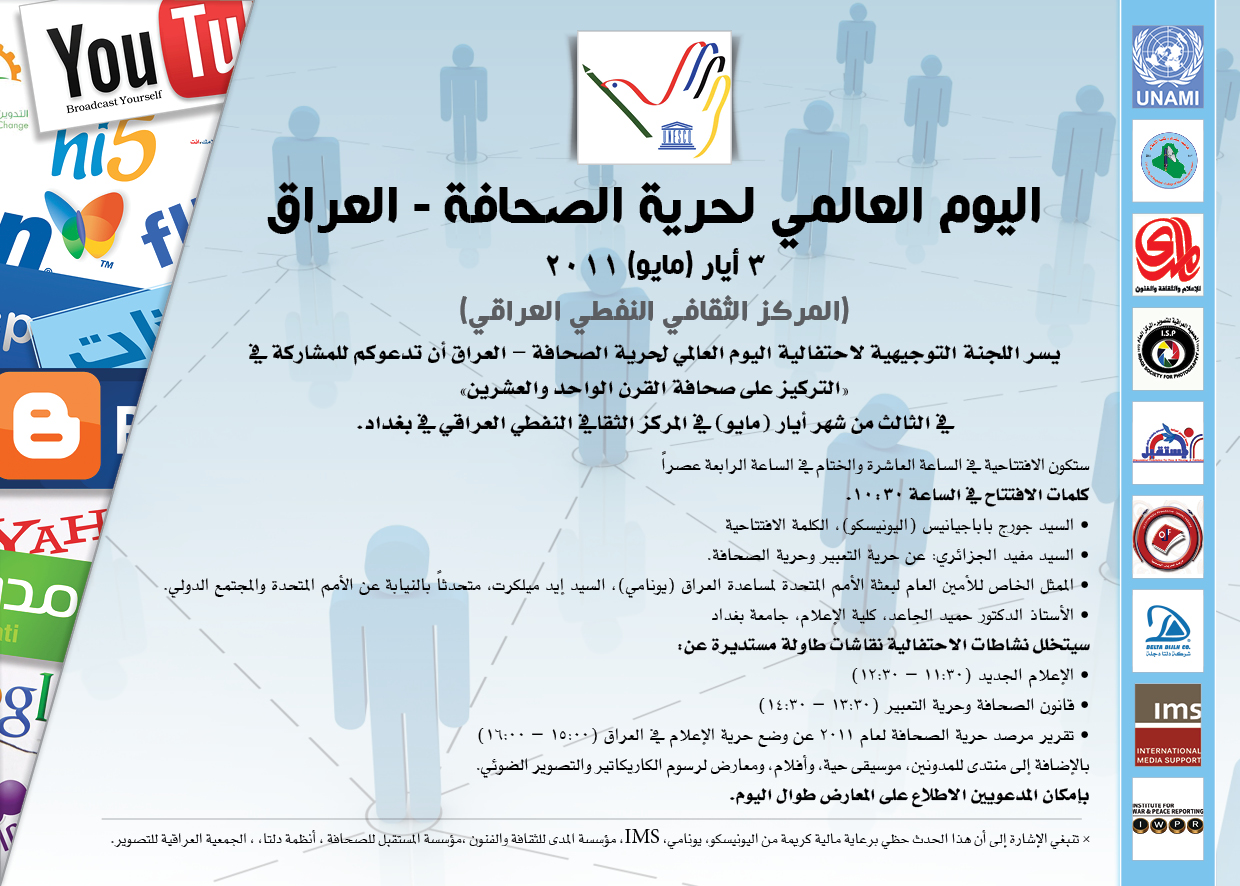
The challenges of the new media at heart of World Press Freedom Day celebrations


“21st Century Media: New Frontiers, New Barriers” is the theme of this year’s World Press Freedom Day, celebrated on 3 May, with major events in Washington DC and New York (USA), alongside local and regional events all over the world."
The Washington conference (1 to 3 May), co-organized by UNESCO with the U.S. State Department and over 20 civil society partners, will examine the growing role of the internet, the emergence of new media and the dramatic rise in social networking in recent years. The Director-General of UNESCO, Irina Bokova, will open the conference alongside Judith McHale, Under Secretary of State for Public Diplomacy and Public Affairs, U.S. Department of State.
Speakers at the conference will include bloggers and internet journalists from North Africa and the Middle East, as well as other media and freedom of expression professionals from all over the world.
On 3 May, Ms Bokova will award the UNESCO/Guillermo Cano Press Freedom Prize. Imprisoned Iranian journalist Ahmad Zeidabadi is the winner of this year’s prize. The award-ceremony will take place at the National Press Club in Washington DC (3.30 to 5 p.m.).
This year’s World Press Freedom Day also marks the 20th anniversary of the Windhoek Declaration for the promotion of free and pluralistic media. The Declaration was adopted after a conference held in Windhoek (Namibia) on the development of a free African press. It emphasized the importance of an independent press for the development and preservation of democracy and economic development. Two years later, the UN General Assembly established World Press Freedom Day.  
The anniversary will be commemorated at a special event at United Nations Headquarters in New York on 4 May. On the same day in Windhoek, a regional conference will be held to review the future of the media in Africa. A publication analyzing media freedom in Africa over the past two decades will be launched on this occasion.              
Also noteworthy are the celebrations of World Press Freedom Day in Tunisia and Egypt, where journalists are now able to work more freely and exercise the right to freedom of expression. 
29.04.2011

Source: UNESCOPRESS
Read the original press release here.

التسميات: , , ,